Whistling Past the Runway
Chapter 2 - Air Force Versus Navy, This Was Not A Game, But Both Sides Lost
Chapter 3 - The Need, the Need For Speed
Milburn "Mel" Apt and the quest to exceed Mach 3
This article was originally going to follow one I wrote on the Junkers Ju-86 which involved a quest for altitude, so it was completely appropriate that this article should involve a quest for speed. Unfortunately, after 3 1/2 years I have only written a couple of paragraphs on this one, and another topic has intruded itself into the intervening article.
Seventy years ago tomorrow (today being 26 September 2026), for the first time in history a human being exceeded the speed of Mach 3 in atmospheric flight.
Even now, over two thirds of a century later, this is not a commonplace achievement. There are only two or three production aircraft models in the world that could hit that speed (the Lockheed SR-71/A12
reconnaissance planes, the Mig 25, and presumably the Mig 31). Of those planes, there were only 32 of the Lockheed planes produced and they were supposedly retired in the 1990s, and the Mig-25 could only achieve Mach 3 for short periods of time by burning out its engines (and is no longer in active service with any air force). So my guess would be less than a couple of hundred people have reached that speed in those two families of planes. The North American XB-70 could also hit that speed but it was never put into production, two were built and one was destroyed in an accident. The remaining plane ended up at the US Air Force Museum in Dayton, Ohio.
As of this writing, somewhere between 550 and 600 astronauts and cosmonauts have either reached earth orbit or made a suborbital flight that would have exceeded the equivalent speed of Mach 3. In addition, test aircraft such as the Bell X-2 article on Grokipedia and article on Wikipedia (one of the subjects of this article) and the North American X-15 have exceeded that speed (the X-15 reached speeds over Mach 6.5 during tests in the 1960s).
The bottom line: In 70 years less than a thousand people have gone that fast, and Mel Apt was the first one.
More to come .. and I have to finish this before 27 September 2026 .. (note almost five years later -- just made it!)
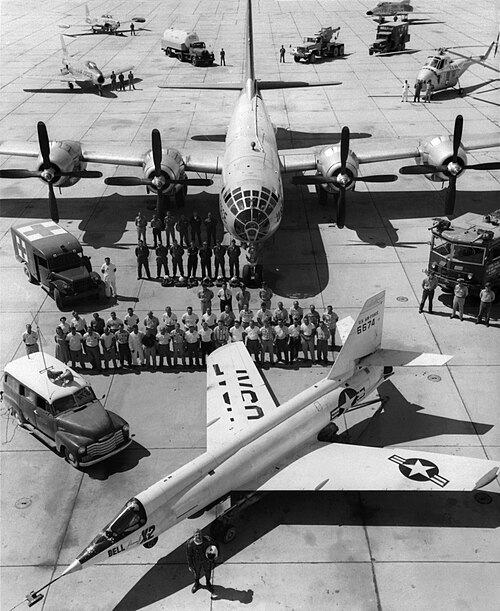 Bell X-2 with B-50 mothership (Wikimedia)
26 August 2026. I just found this unfinished article again, and realized to my horror that my self proclaimed deadline for finishing it is now just over a month away. Almost five years have gone by .. unbelievable!
In the immortal words of Alan Shepard, let's "light this candle" ..
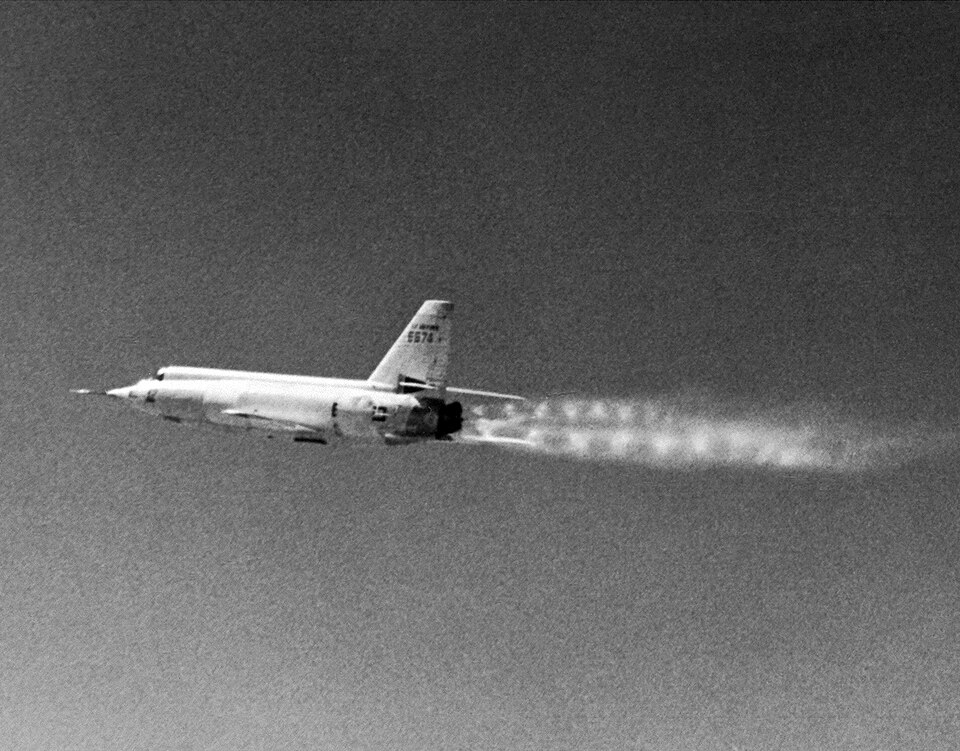 Bell X-2 in flight (Wikimedia)
In 1939, just a few months before World War II broke out, the fastest aircraft in the world reached 469 mph. At the end of World War II six years later, that speed had been matched or exceeded by front-line combat planes still using piston engines, but there were already jet and rocket powered aircraft in service and coming online which topped out around 100 mph faster than that. The fastest combat plane of the war, the Me-163 Komet could reach a speed of 700 mph, but other than that was not a terribly practical military aircraft. The rocket powered Komet is believed to have shot down between 9 and 18 allied aircraft against a loss of 10 of the Me-163s, and was so dangerous to fly that it is entirely possible that more Komet pilots were killed than all the aircrew who died in the planes they shot down.
Planes like the Komet may have been militarily effectively useless, but the raw speed they were capable of attracted the attention of and captured the imagination of aircraft designers in several countries as World War II came to an end and the world entered the period of the Cold War between the USA and the Soviet Union.
Development on the Bell X-2 "Starbuster" rocket propelled aircraft began in 1945. It had a protracted gestation period (much like this article) because it was designed to fly at speeds of Mach 2 to Mach 3 plus, and the technologies to achieve this simply did not exist in the immediate post WWII era. As a result, the first flight did not take place until 1952, which was an unpowered glide flight to make sure the vehicle could actually fly. The second prototype never actually flew under its own power, being destroyed in an accident on 12 May 1953 which killed test pilot Skip Ziegler and a crewman (Frank Wolko) aboard the Boeing B-50 mothership it was attached to.
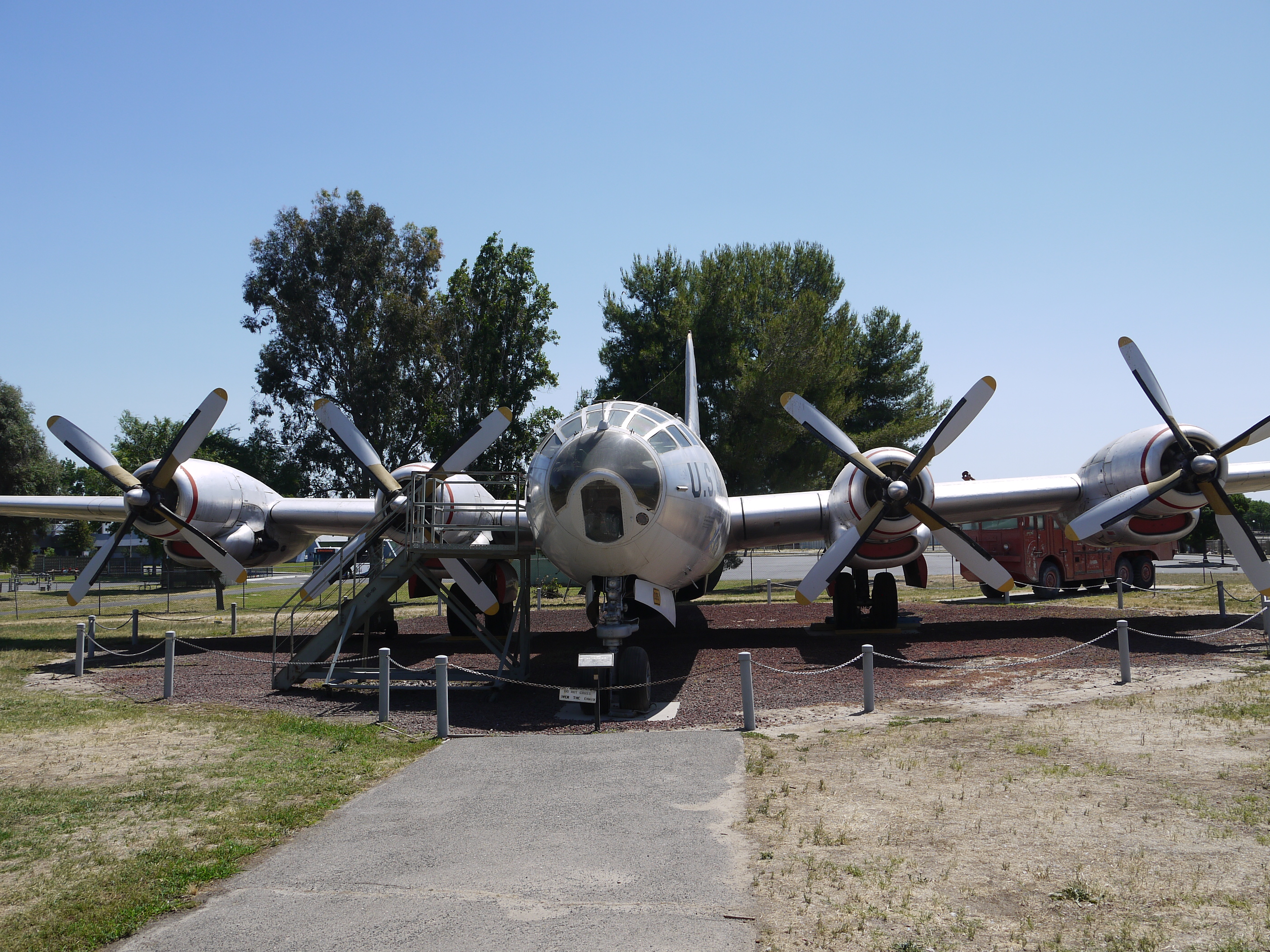 Boeing WB-50D, Castle Air Museum
(The WB-50D is not the same model B-50s that were dropships for the X-2 program, but is similar. You can tell the B-50 from the earlier B-29 by the completely different shape of the engine nacelles).
The first prototype finally flew on 18 November 1955. By this time production aircraft had become exponentially faster than they had been 10 years before, and with interceptors like the
Lockheed YF-104 prototype achieving speeds of Mach 2.3, the fact that the X-2 which had been in development for so long was only able to reach Mach 2.87 in July 1956 was disappointing, to say the least. But it was not going to be easy to exceed Mach 3. Pete Everest, who was setting records flying the craft, had reported that the flight controls were less and less effective as the plane flew faster and faster. Simulations and wind tunnel studies also suggested these problems would increase as the speed approached Mach 3.
Pilots Iven Kincheloe and Mel Apt were given the assignment of pushing the plane closer to its hoped for performance speeds. On 7 September 1956 Kincheloe became the first man to fly above 100,000 feet, taking the X-2 to an altitude of 126,000 feet.
20 days later, Apt took the controls in an attempt to exceed Mach 3. Dropped from a B-50 mothership high above the Antelope Valley of California, Apt put the pedal to the metal and took the craft to a speed of Mach 3.2 (almost 2100 miles per hour). To give you an idea of how fast that is, traveling at that speed you could leave Los Angeles, California, and arrive in Atlanta, Georgia, an hour later.
There is no way to know exactly what went through Apt's mind next. The most likely explanation is that at his rate of speed he realized he was in danger of hurtling beyond glide range back to Rogers Dry Lake which was the designated landing area. It's also possible that his instrumentation was giving him false speed readings so he attempted to turn the aircraft at a speed where it was unsafe to do so.
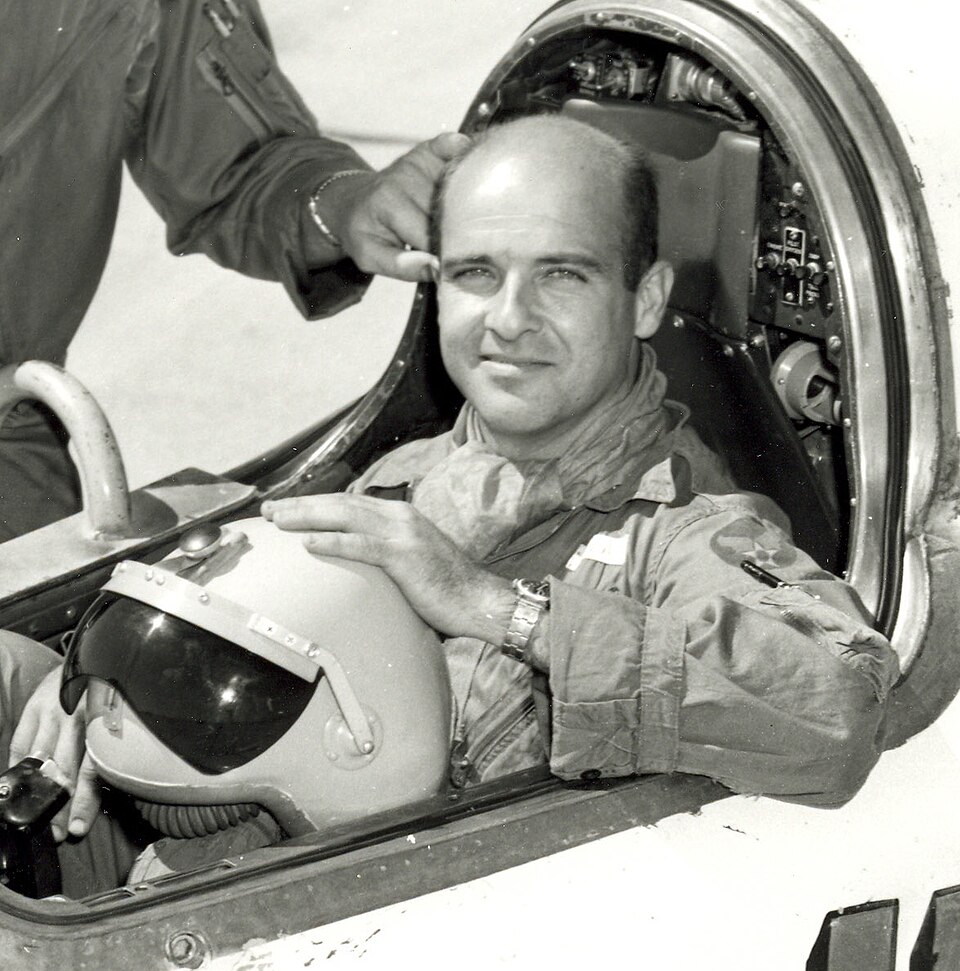 Captain Milburn "Mel" Apt in cockpit of Bell X-2 (Wikimedia)
The results were immediate and disastrous. The X-2 began spinning violently out of control. Apt ejected the escape capsule from the plane, but the capsule was not designed to be ridden all the way to the ground, the parachute for it was insufficient to slow it enough to make such a process survivable. The escape capsule was such a poor design that test pilot
Scott Crossfield described it as "a way to commit suicide to keep from getting killed".
Once clear of the X-2 the pilot was then supposed to bail out of the escape capsule and use his personal chute to attempt to land safely.
Apt did not do so. No one knows why, whether he was waiting to get to a lower altitude and lost consciousness before he could bail out, or he was disabled or unconscious from the severe G forces he had undergone when the escape capsule was blown clear of the X-2.
When rescuers arrived at the crash site of the escape capsule, they found Apt's body inside. The X-2 itself crashed five miles away. It was not salvageable, and no more examples of the craft were constructed, marking the end of the program. Two planes had been built, the explosion while attached to a B-50 had destroyed the second prototype, and the loss of control and crash of the first one destroyed it.
Three years later the North American X-15 took up the gauntlet where the X-2 had been dropped. Three X-15s were built and they flew 199 times, with only one ending badly (Flight 191 broke apart in the airspace above Kern County, California, killing the pilot,
Michael J. Adams). In the nine year lifespan of the project, X-15s flew to speeds of Mach 6.7 and altitudes over 50 miles. Two missions (90 and 91, piloted by Joseph A. Walker) exceeded the 62 mile altitude of the Karman line, making him an astronaut according to the FAI (the World Air Sports Federation AKA the Federation Aeronautique Internationale). The US military had its own definition of the start of space (50 miles) so according to that definition nine of the X-15 pilots were astronauts.
As far as I can tell the second person to reach Mach 3 was also Joseph A. Walker on Flight 29 of the X-15 program, which took place on 12 May 1960, nearly four years after Mel Apt took his final flight. Probably coincidentally, this was also exactly seven years after the destruction of the second X-2 prototype over Lake Ontario in 1953. Mel Apt was the first person to exceed Mach 2, and Joseph Walker was the second.
Other than the rocket propelled X-15, planes followed such as the Lockheed SR-71/A-12 which routinely flew at speeds and altitudes that the X-2 was first designed to explore. A number of the SR-71s and A-12s also ran into difficulties because of the extreme conditions during flight and 12 of the 32 built were lost in accidents but there was only one fatality, Jim Zwayer, in 1966.
Mel Apt had two daughters. His older daughter,
Sharman Apt Russell, was two years old when he died. She is an award winning science writer and essayist. She has written at least one essay about her father which was published in 2019. It looks like her next book, The Desert Dreams of Flying to the Moon (to be released in 2027) will have biographical material about her father as well as other test pilots such as Glen Edwards and Neil Armstrong.
Sharman has a younger sister, Lorrie Epling. She was invited to appear at Edwards Air Force Base in 2016 when a museum exhibit about her father and the X-2 was created for the 60th anniversary of the record breaking but tragic flight.
In March 1957 Mel was posthumously awarded the Distinguished Flying Cross from the US government. The medal was presented to his widow Faye Kelley Baker Apt, who died in 2015. I have no idea if she remarried after his death but it would be plausible as she was only 32 when he died.
In October 2009 I was in Kansas for a genealogy trip. I had gone to Independence, Kansas in Montgomery County with my oldest brother Richard to try and find out more about our second great grandfather, David Miller, who had died in Montgomery County in 1872. While in Independence I connected with a cousin previously unknown to me, Don Miller, who lived in Westphalia, Kansas. He invited Richard and I to come up and visit. I accepted his offer but Richard declined, Independence is not that far from Tulsa, Oklahoma, where Richard lived, and he decided to head home since he was so close.
I had to head north anyway to get to Westphalia (although I ended up going farther than that to a cemetery in Carbondale, Kansas just to make sure I hadn't missed anything on my two earlier visits to that particular cemetery). It helped that the weather, which had been really cold a few days before, had turned much warmer. The most direct route from Independence to Carbondale goes right past Buffalo, Kansas, where Mel Apt was born and is buried.
I stupidly hadn't brought the address or directions to the cemetery where Mel Apt is buried (not to mention directions to his grave once you are in the cemetery, although there might be a map and a list of names tacked up somewhere in the cemetery, you do see that from time to time in some of these small rural cemeteries). However, I did pull off of Kansas 75 on the outskirts of Buffalo. "Outskirts" is a bit of a misnomer; as of 2026 Buffalo only has a population of about 200 people, and it probably wasn't much bigger (if at all) 17 years ago. Anyway, I drove around a bit and looked at some farms and looked at some domestic animals and took pictures of them. Then I got back in the rental car and headed for Carbondale, and from there to Westphalia to meet Don and his wife Shirley Miller.
 Buffalo, Kansas area (October 2009)
I'm planning another trip to Kansas in the next few years, and this time I hope to actually make it to the Buffalo Cemetery (yep, that's the name of it) and find that marker for Mel Apt and pay my respects.
There is no actual moral to this story, but there is an obvious observation. Speed and altitude are dangerous, and extreme speed is extremely dangerous. Pushing the envelope sounds great but when the envelope pushes back it can be a real bitch. Mel Apt, died age 32. Skip Ziegler (not speed per se but cutting edge technology) age 33. Iven Kincheloe age 30 (F-104 crash at Edwards AFB). Joseph A. Walker age 45 (killed in the collision of his F-104 with one of the two XB-70 prototypes). Jim Zwayer age 47 (SR-71 mishap over New Mexico). Michael J. Adams age 37 (uncontrollable spin while piloting an X-15 over Kern County, California).
So far in this series we have one article each on altitude and speed (and one random but heartbreaking mid air collision). If I'm working on themes here, logically the next article will be on range or endurance, which allows for lots of possibilities.
Sources:
Bell X-2 (Grokipedia)
Bell X-2 (Wikipedia)
North American X-15 (Grokipedia)
Milburn "Mel" Apt on Wikipedia
Michael J. Adams (test pilot and astronaut)(Wikipedia)
Joseph A. Walker (test pilot and astronaut)(Wikipedia)
Chapter 4
Higher, Faster, Now Farther